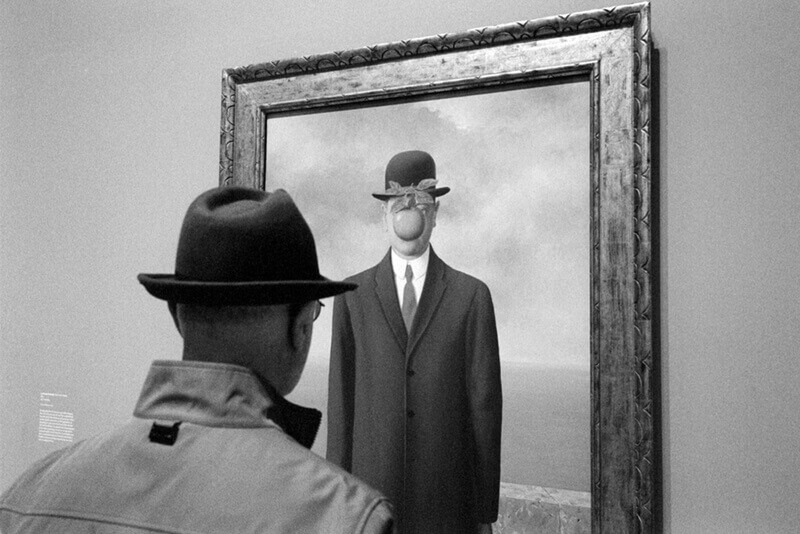
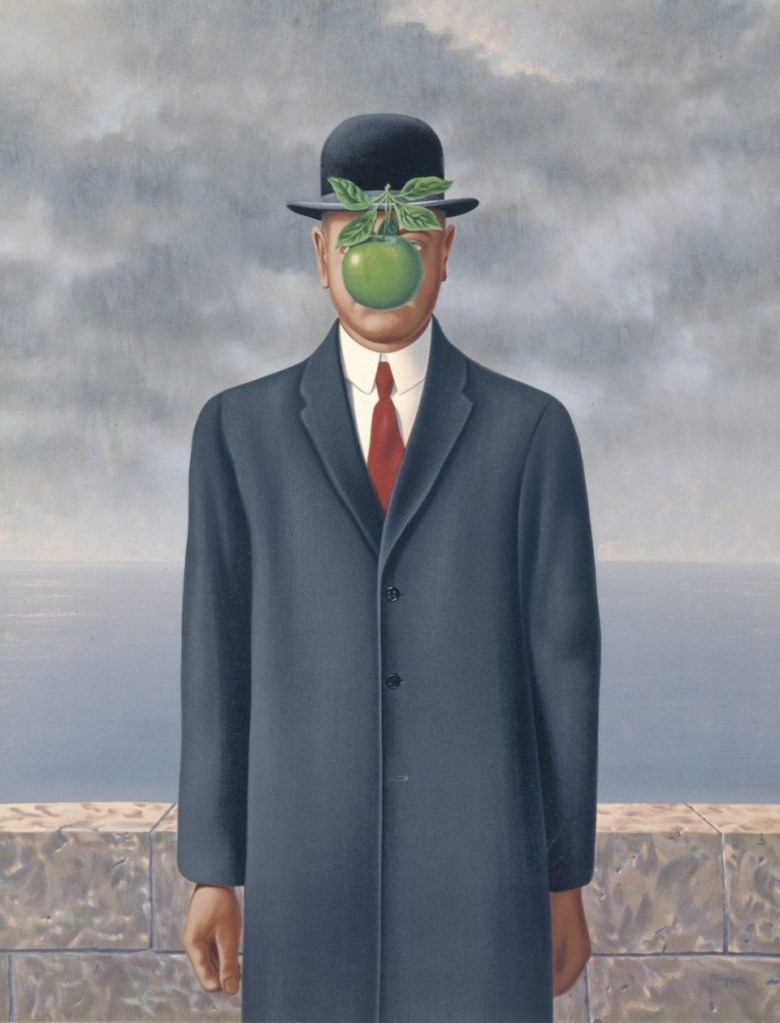
The Son of Man, or as I remember him, The Apple Man.
Magritte painted The Son of Man as a self-portrait. The painting consists of a man in an overcoat and a bowler hat standing in front of a short wall, beyond which is the sea and a cloudy sky. The man’s face is largely obscured by a hovering green apple. However, the man’s eyes can be seen peeking over the edge of the apple. Another subtle feature is that the man’s left arm appears to bend backward at the elbow. At the start of 1946, Margritte was painting in both his realist style and his impressionist style. Some of his works, like The Son of Man, were already headed toward more extreme colors. This extreme style, closer to some of Van Gogh’s paintings, would accelerate in late 1947 when he was invited to hold his first solo exhibition in Paris at the Galerie du Faubourg in May 1948. Today, along with Persistence of Memory by Salvador Dali, The Son of Man has become the most iconic image of Surrealism Movement.
La trahison des images or ‘The Treachery of Images’ cleverly highlights the gap between language and meaning. Magritte combined the words and image in such a fashion that he forces us to question the importance of the sentence and the word. “Pipe,” for instance, is no more an actual pipe than a picture of a pipe that can be smoked. Magritte likely borrowed the pipe motif from Le Corbusier’s book ‘Vers une architecture’ (1923), since he was admirer of the architect and painter, but he may also have been inspired by a comical sign he knew in an art gallery, which read, “Ceci n’est pas de l’Art.
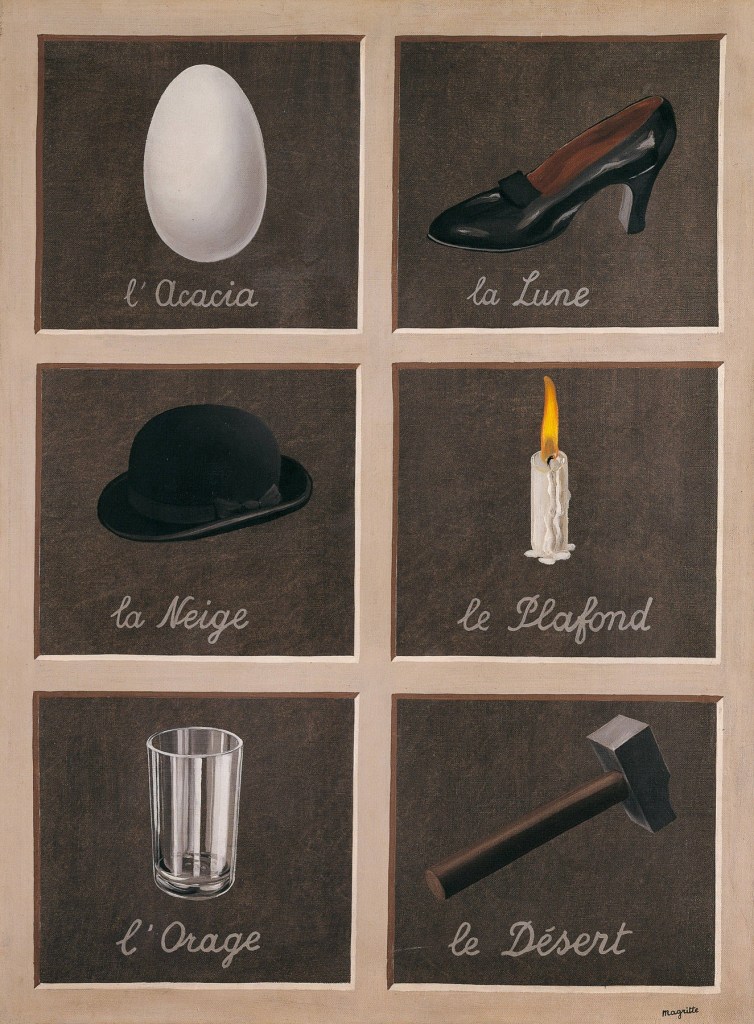
René Magritte’s cerebral, enigmatic paintings and prints helped define the imagery and philosophy of the Surrealist movement. His most famous works, including The Treachery of Images (1929) and The Son of Man (1946), explore the illusory power of art and juxtapose mundane and fantastical iconography. Magritte was born in Belgium. After a stint at the Académie Royale des Beaux-Arts in Brussels and employment as a designer and draftsman, he moved to Paris and became involved with the Surrealist trailblazer André Breton.
 My surreal world