Dada stands for a movement of radical, cultural revolt against art by artists themselves who, appalled by developments in contemporary society, recognised that art was bound to be a product, reflection and even support of that society and was therefore criminally implicated. Dada stands for exacerbated individualism, universal doubt and aggressive iconoclasm.
The Dada movement consisted of artists who rejected logic, reason, and aestheticism of modern capitalist society, and instead, expressing nonsense, irrationality, and anti-bourgeois protest in their works. It was formed in Zurich as a negative reaction to the horrors and folly of the first world war. Influenced by Cubism, Expressionism, and futurism, Dada art included themes of music, literature, painting, sculpture, performance art, photography, and puppetry. Its very existence was a political act and it challenged traditional views of government, society, and institutions. Dada artists expressed their discontent toward violence, war, and nationalism and maintained political affinities with radical left-wing and far-left politics. The movement was very unusual for its time, even avant-garde, and provoked society into communicating themes that hadn’t really been questioned before. Below I have included an image of a poster depicting the kind of art made during the Dada movement.
“Dada is the expression of a state of mind”. This statement summarises what Dadaism is for me. It was a way for artists to express what was on their minds in ways that reflected the chaos and nonsense in society. Art is something that has always either brought people together or set a divide on opinions and when it comes to politics, it is a way to include everyone, a way for anyone to express concerns. It also goes on to say that “others have sought to annex poetry to the Marxist revolution”. In our lecture, we spoke about Karl Marx who was a German philosopher during the 19th century, working primarily in the realm of political philosophy and advocating for communism. This is where the term “Marxism” comes from. It is Marx’s theory that says that society’s classes are the cause of struggle and that society should have no classes. He believed that this conflict would ultimately lead to a revolution in which the working class would overthrow the capitalist class and seize control of the economy.
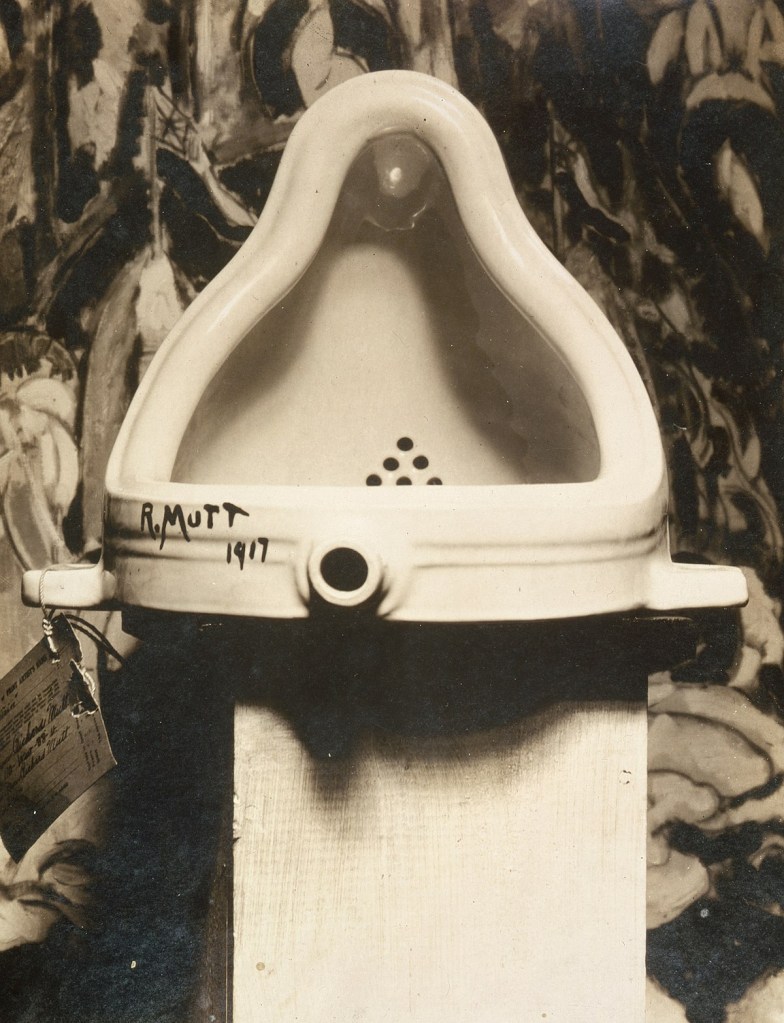
A clear example of where art was used to target a political issue is during the Dada movement. As well as being anti-war, dadaism was also anti bourgeoisie and had political affinities with the radical left. Marcel Duchamp was a key figure in the Dada movement and was well known for his paintings and sculptures. Duchamp connected with the Dada group in Zurich and brought back the ideas of absurdity and anti-art. A well-known example of Duchamp’s involvement with the movement was his sculpture called Fountain; a urinal which he submitted to the Society of Independent Artists exhibit in 1917. All pieces submitted here were displayed, however the show committee, rejected it from the show as they did not feel as though this was art. This caused disorder within the dadaist community and eventually lead to Duchamp resigning from the board of the Independent Artists. When explaining the purpose of his sculpture, Duchamp stated that “everyday objects raised to the dignity of a work of art by the artist’s act of choice”. In his presentation, the urinal’s positioning was adapted and turned upside down, revealing the form of a “fountain”. “The impact of Duchamp’s Fountain changed the way people view art due to his focus upon “cerebral art” contrary to merely “retinal art”, as this was a means to engage prospective audiences in a thought-provoking way as opposed to satisfying the aesthetic status quo “turning from classicism to modernity”. It was suggested that he purposefully chose a urinal as it was disagreeable and not many people would like looking at one and at the time this was the whole point; he wanted to make a point in society and create the unexpected. It was also argued that there were strong sexual connotations with the fountain and it was said that “In placing the urinal horizontally it appears more passive, and feminine while remaining a receptacle designed for the functioning of the male penis”.
Painted onto the urinal are the words”R. Mutt”. It has been argued that he was indirectly referring to the German word “Armut” meaning poverty. Duchamp said himself that the “R”, stood for Richard, French slang for “moneybags”. Which makes the Fountain a political commentary on poverty and the social class system. I think this was such a powerful statement to the political system, reinforced by the reaction from society.
 My surreal world